
Getting into a car accident is always a stressful experience, but an Uber accident Missouri brings a unique set of questions. You might feel overwhelmed by medical bills or confused about which insurance company is actually responsible for your recovery.
At Harper, Evans, Hilbrenner & Netemeyer, our personal injury lawyers believe every Missourian deserves clear and helpful information during difficult times like these. Whether you were a passenger, a driver, or someone in another vehicle, understanding your rights is the first step toward moving forward.
Rideshare Injury Claims Missouri: Key Takeaways
- Missouri law requires rideshare companies to provide varying levels of coverage, reaching up to $1 million in liability coverage when a driver is actively on a trip.
- You generally have a five-year window to file a personal injury claim under the current Missouri personal injury statute of limitations (RSMo 516.120).
- Missouri uses a comparative fault system, meaning you can still recover compensation even if you were partially responsible for the crash, though your recovery is reduced by your percentage of fault.
When Uber or Lyft Insurance Applies
One of the most important things to know about an Uber accident in Missouri is that insurance coverage is not always the same. It works like a sliding scale based on the driver’s status in the app. Missouri Revised Statute §379.1702 defines these periods of work to ensure a safety net for victims.
How Insurance Shifts Based on App Status
In Missouri, the amount of insurance coverage available changes the moment a driver interacts with a rideshare app. These shifts are legally defined by “periods” of activity.
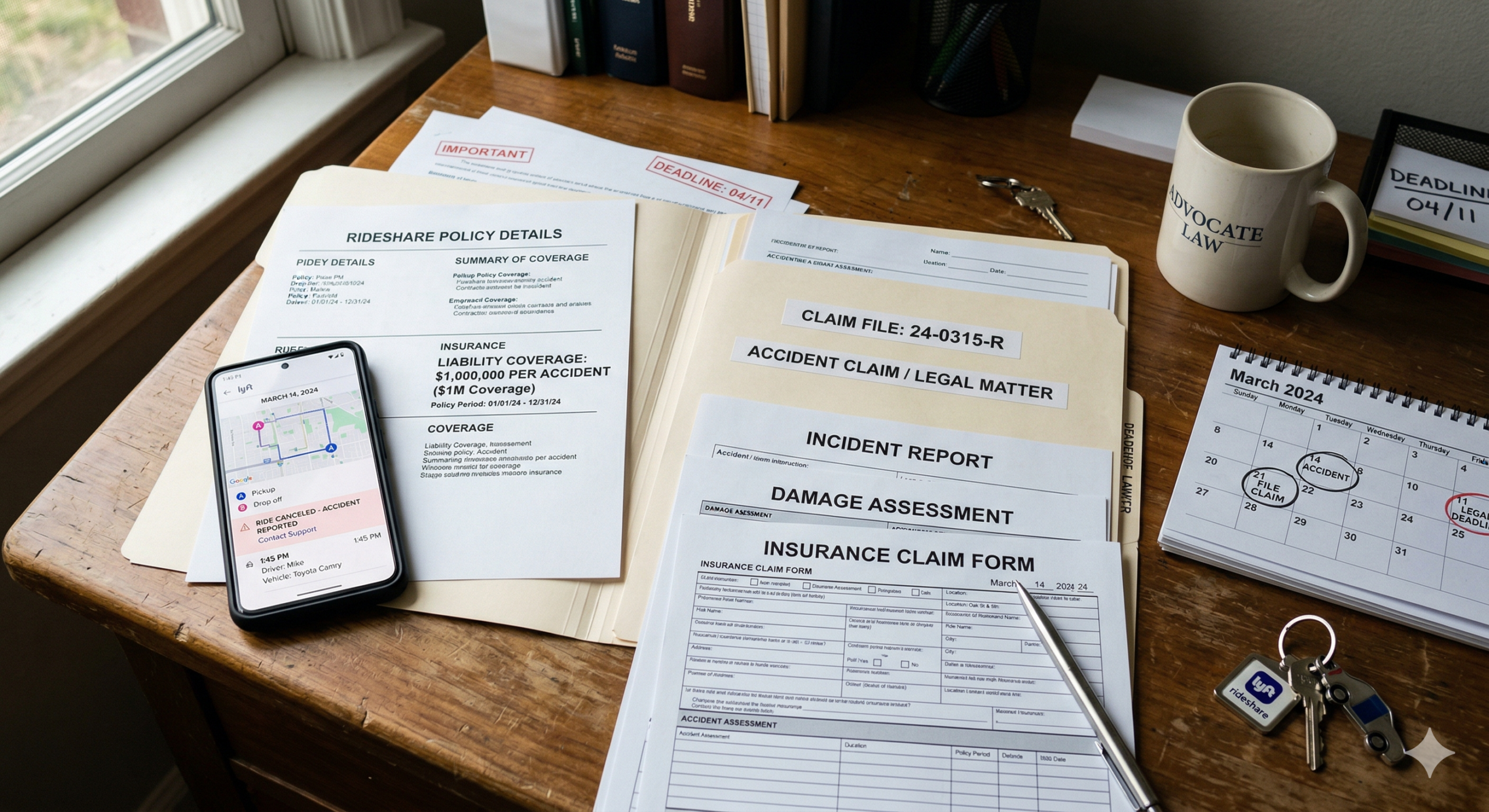
Rideshare accident claim showing insurance coverage, app screen, and legal documents in Missouri.
See Uber’s insurance coverage policy; and Lyft’s insurance coverage policy.
Period 0: The App is Off
When a driver’s app is off, they are operating their vehicle for personal use. In this scenario, the driver’s personal auto insurance is the primary source of coverage. The state-mandated minimum is $25,000 per person for bodily injury, $50,000 per accident for bodily injury, and $25,000 per accident for property damage, as outlined by the Missouri Department of Revenue.
Period 1: The App is On (Waiting for a Request)
Once a driver logs into the app but has not yet accepted a ride, Missouri law (RSMo 379.1702) mandates higher coverage than a standard personal policy.
- Because most personal policies exclude “livery” (driving for hire), Missouri law requires the rideshare company to provide primary liability coverage if the driver’s personal policy denies the claim.
- Coverage Limits provide at least $50,000 per person and $100,000 per accident for bodily injury, plus $25,000 for property damage. Note: Legal experts can highlight this as a “coverage gap” because these limits are significantly lower than active trip limits.
Periods 2 & 3: Ride Accepted or Passenger Onboard
The moment a driver accepts a request or has a passenger in the car, the coverage jumps significantly. During these periods, Missouri law requires the rideshare company (aka the Transportation Network Company or “TNC”) to provide a $1 million primary liability policy that covers both the driver’s liability and protection for passengers involved in a crash.
Coverage Limits and Exceptions
Missouri has strict rules to make sure people are protected after a rideshare injury. According to the Missouri Department of Revenue, all drivers must carry basic liability, but rideshare companies must go much further. When a passenger is in the vehicle, the $1 million limit covers death, personal injury, and property damage.
There are some exceptions to these rules that you should watch out for. For example, if a driver is using a vehicle not registered in the Uber or Lyft app, the company might try to deny the claim. Also, if the driver was engaging in criminal activity or causing intentional harm, standard insurance might not apply as usual.
It is also vital to consider Uninsured and Underinsured Motorist coverage. In many rideshare injury claims, Missouri residents find that the person who hit them did not have any insurance at all. During Periods 2 and 3, the rideshare company’s policy may provide Uninsured/Underinsured Motorist coverage to protect the driver and passengers if they are hit by an at-fault driver with no insurance.
See Uber’s insurance coverage policy; and Lyft’s insurance coverage policy.
Steps to Take Immediately After a Rideshare Accident
The moments after a crash are often a blur, but taking a few simple steps can protect your future. First and foremost, check yourself and others for injuries and call 911 if anyone needs help. In Missouri, you are generally required to report accidents to the police if there is an injury or property damage over $500.
Next, you should document everything you can with your phone. Take pictures of the cars, the road conditions, the rideshare decals (e.g. Uber, Lyft), and any visible injuries you have sustained. If there are witnesses nearby, ask for their names and phone numbers because their accounts can be very helpful later.
Specifically for an Uber accident in Missouri, make sure you take a screenshot of your ride receipt or the driver’s profile in the app. This is crucial evidence to help prove which “Period” of coverage was active at the time of the collision. You should also report the accident through the app’s help section as soon as you are safe. Finally, seek medical attention even if you feel okay, as some injuries like whiplash take time to appear.
Suing the Driver vs. the Rideshare Company
A common question we hear is whether you should sue the individual driver or the multi-billion-dollar company. In most cases, you are actually dealing with the insurance companies representing these parties. Because Uber and Lyft drivers are usually classified as independent contractors, suing the company directly can be difficult under Missouri law. Evidence of negligent hiring or supervision could be useful here.
The one-million-dollar insurance policy, however, is there specifically to handle these situations. You are essentially making a claim against that policy to cover your bills. Navigating this distinction is key to ensuring you are pursuing the correct source of recovery.
Navigating this distinction requires a deep understanding of personal injury laws in our state. Most people find that their goal is not necessarily a courtroom battle but receiving a fair settlement that covers their losses. Whether the money comes from the driver’s insurance or the company’s policy, the priority is making sure you have the resources you need to recover fully.
Common Challenges in Rideshare Claims
Even with high insurance limits, getting a fair payout can be a challenge. Insurance companies are businesses, and they often try to save money by offering low settlements. One common hurdle is the coverage gap, which happens when the driver’s personal insurance says they were working, but the rideshare company says the app wasn’t fully active.
Another challenge involves Missouri’s comparative fault rules. This means that if you were even slightly responsible for the accident, your total compensation could be reduced by your percentage of fault. For example, if you were 10% at fault, you might only receive 90% of your total damages.
Data privacy is also a concern for many victims. Getting the GPS and activity data from companies like Uber or Lyft often requires a formal legal request. Without this data, it can be hard to prove exactly what the driver was doing at the time of the crash. This is why having a team that knows how to handle Missouri rideshare insurance law is so beneficial for your case.
Contact Harper, Evans, Hilbrenner & Netemeyer Today
If you have been hurt in a rideshare accident, you do not have to face the insurance companies alone.
Contact Harper, Evans, Hilbrenner & Netemeyer today for a free consultation, or call (573) 665-2503.
We are here to listen to your story and help you understand your legal options with compassion and honesty.
Missouri Personal Injury Statute of Limitations: Bottom Line
The most important thing to remember is that time is a factor in every legal claim. The Missouri personal injury statute of limitations generally gives you five years to file a lawsuit, but waiting too long can lead to lost evidence or fading memories. Taking action early ensures that your rights are protected and that you have the best chance at a positive outcome for your family.
Missouri Uber Accident: FAQ
It is natural to have many questions after an Uber accident. Missouri drivers and passengers often find themselves in. Here are some of the most common questions we hear at our firm to help you find clarity.
How much is my rideshare accident claim worth? Every case is different, but compensation can include medical bills, lost wages, and pain and suffering. The total value depends on the severity of your injuries and the available insurance coverage.
What if the driver was not at fault? If another driver caused the accident, we would typically file a claim against that driver’s insurance first. If their limits are too low, the rideshare company’s underinsured motorist coverage may kick in.
Do I still have a case if I wasn’t wearing a seatbelt? Yes, you can still file a claim in Missouri. However, under comparative fault rules, your compensation might be reduced if the insurance company can prove that not wearing a seatbelt made your injuries worse.
Will I have to go to court? Most rideshare accident claims are settled through negotiations with the insurance company without ever setting foot in a courtroom. We only go to trial if the insurance company refuses to offer a fair settlement.
What if I were an Uber driver who got hit? As a driver, you have rights too. If another person caused the accident while you were working, you can seek compensation from their insurance and potentially use the rideshare company’s extra coverage.
About Our Law Firm
Harper, Evans, Hilbrenner & Netemeyer has been a trusted part of the Missouri legal community for decades. We take pride in being approachable and plainspoken because we know that legal talk can be confusing when you are already stressed. To learn more about us and our commitment to the Columbia area, please visit our firm profile. We are dedicated to providing the high-quality legal support you deserve while treating you like a neighbor.
Disclaimer: The information provided in this guide is for informational purposes only and does not constitute legal advice. No attorney-client relationship is formed by reading this content. Please consult with a legal professional directly, regarding the specifics of your case.