
On March 27, 2026, Tiger Woods rolled his Land Rover on Jupiter Island, Florida, after clipping a truck’s trailer on a narrow residential road. He blew a 0.00 on a breathalyzer but refused a urinalysis. Deputies found two hydrocodone pills in his pocket and arrested him on DUI charges.
A court later granted prosecutors access to his prescription drug records in a four-minute ruling, overriding his legal team’s privacy objections.
This case raises legal questions that Missouri courts answer every week: Who can access a driver’s medical records? What counts as intoxication when no alcohol is involved? If you were hurt by a driver impaired by prescription medication, here is what Missouri law says about your rights.
Our car accident attorneys at Harper, Evans, Hilbrenner & Netemeyer represent injured Missourians across Boone, Cole, Callaway, and Howard counties. If an impaired driver injures you, this is what you need to know.
The Battle Over Medical and Drug Records in High-Profile Crashes
When prescription drug impairment is suspected, the evidentiary fight often starts before trial: both sides battle over medical records, pharmacy logs, and toxicology reports. In the Woods case, a judge compelled production of his drug records but applied a protective order limiting access to prosecutors, law enforcement, state experts, and the defense team.
Missouri civil cases follow the same logic.
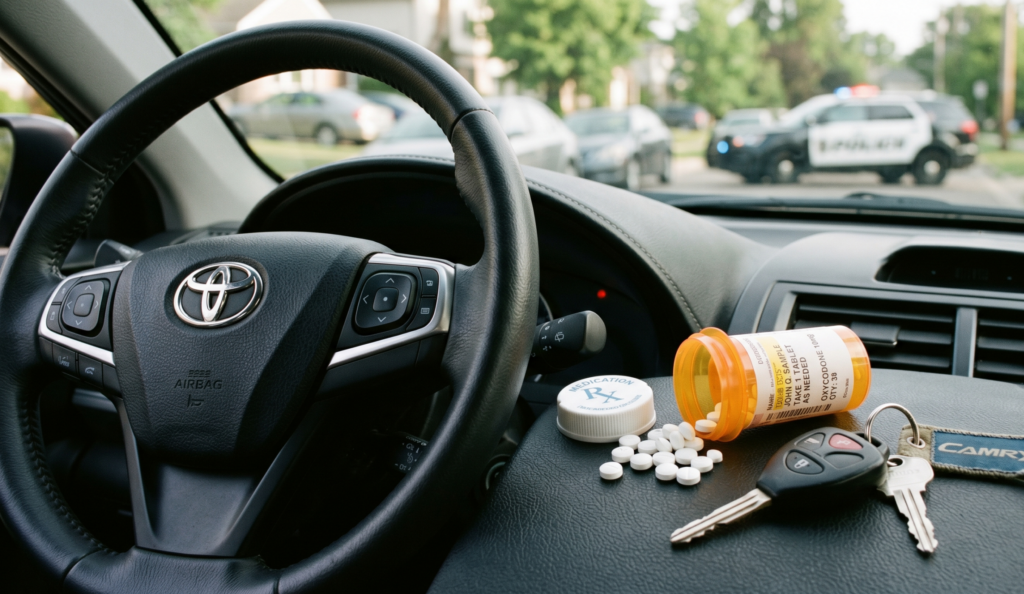
Interior view of a Toyota vehicle with a steering wheel and a spilled open prescription medication bottle on the dashboard, with a police car visible in the background through the windshield.
Analyzing the Recent Discovery Rulings
In practice, if you believe the driver who injured you was impaired by opioids or another medication, your attorney can petition the court to compel production of those records. When impairment is the central theory of liability, courts consistently find that the relevance outweighs the privacy interest.
Missouri’s Legal Standard for “Operating While Intoxicated”
Most people associate DWI with alcohol and a 0.08 BAC. Missouri law is broader than that.
Mo. Rev. Stat. Section 577.010 defines operating while intoxicated as driving while in an “intoxicated condition,” which includes impairment by alcohol, controlled substances, drugs, or any combination thereof. There is no minimum BAC threshold. The test is functional: was the driver’s ability to operate safely impaired at the time of the crash?
A driver can register 0.00 on a breathalyzer and still be legally intoxicated if prescription medication impairs their driving.
DWI vs. DUID: How Medication Impacts Liability
Unlike alcohol, drug impairment requires blood analysis and expert toxicological testimony rather than a simple breath test. Defense counsel frequently argues that a drug was taken at a therapeutic, non-impairing dose. Your legal team must counter with credible forensic expertise.
Missouri’s implied consent law, Mo. Rev. Stat. Section 577.020 deems every Missouri driver to have consented to chemical testing when law enforcement has reasonable grounds to believe they are intoxicated. Refusing that test triggers license revocation, and, in a related civil case, that refusal can be introduced as evidence that the driver knew they were impaired.
The Physician-Patient Privilege in Missouri Courts
The physician-patient privilege under Section 491.060 protects the confidentiality of communications between patients and their doctors. It does not, however, shield a driver’s medical history from scrutiny when that history caused someone else’s injury. In Boone, Callaway, and Cole counties, Missouri courts regularly compel production of relevant records when impairment by prescription medication is the central liability issue. That evidence can dramatically strengthen your claim.
Comparative Fault and Civil Damages in Complex Collisions
Missouri follows a pure comparative fault system. Even if you share some responsibility for the crash, you recover damages proportionate to the other driver’s percentage of fault. If the impaired driver is found 80 percent at fault, you recover 80 percent of your total proven damages.
Recoverable damages in a Missouri car accident case typically include:
- Medical expenses, past and future treatment costs tied directly to your injuries
- Lost wages and earning capacity, income lost during recovery and any long-term reduction in earning ability
- Property damage, vehicle repair or replacement
- Pain and suffering, physical pain, emotional distress, and reduced quality of life
- Punitive damages, available in cases of especially reckless misconduct
Protecting Your Rights Following a Serious Collision
Whether you were injured on Business Loop 70 in Columbia, Highway 63 toward Jefferson City, or Route 54 through Callaway County, take these steps immediately:
- Seek medical attention right away, even without obvious symptoms.
- Document the scene with photographs, witness contacts, and dashcam footage.
- Do not give a recorded statement to the other driver’s insurer without an attorney.
- Request the police report, including any documented observations of impairment.
- Contact a Missouri car accident attorney before accepting any settlement offer.
Missouri’s general personal injury statute of limitations is 5 years, but pharmacy records are purged, and witnesses’ memories fade. Acting quickly protects your evidence and your rights.
Speak with a Missouri Car Accident Attorney
The Tiger Woods crash update spotlights legal standards that apply to ordinary Missouri crash victims every day. If a driver impaired by prescription medication hurt you, you deserve attorneys who know exactly how to pursue that case.
At Harper, Evans, Hilbrenner & Netemeyer, our team has represented injured Missourians across mid-Missouri for decades. We handle every case on a contingency fee basis, meaning you owe nothing unless we recover compensation for you.
Call (573) 442-1660 or contact us today for a free, confidential case evaluation.
Disclaimer: This article is for general informational purposes only and does not constitute legal advice. Reading this content does not create an attorney-client relationship. Laws may have changed since publication. If you have been injured in a car accident, consult a qualified Missouri personal injury attorney to evaluate the specific facts of your case.